硫黄市場の変動:価格安定化の背景と今後の展望
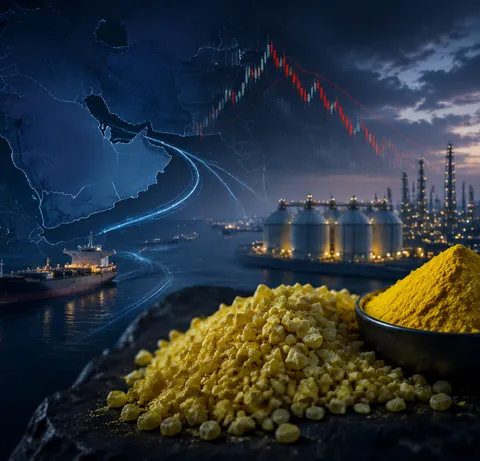
Granular sulfur at Zhenjiang Port fell from RMB 7,100/t in early October to RMB 4,725/t at month-end, a single-month drop of 33.45%. Since entering November, prices have see-sawed repeatedly in the RMB 4,700-5,100/t range, with the decline clearly slowing and localized probing rises appearing. But the underlying mechanism of this stabilization is that deep inversion between domestic and offshore prices has cut off marginal import supply, and a structural tightness in tradable cargo has underpinned quotations — not that end demand has given a signal of volume expansion. The recent halt in the decline has stabilized the "speed of the fall", not the "direction".
I. The direct mechanism of stabilization: the import channel is frozen by price inversion
The hardest floor constraint currently comes from imports. Although Middle East official contract prices for November were cut across the board, sellers are still quoting around USD 800/t CFR to East Asia, which translates into a landed cost of over RMB 6,100-6,400/t, while spot at Zhenjiang Port is only in the RMB 4,900-5,100/t range — import trade is deeply loss-making. This means new imported cargo cannot enter the domestic market on commercial logic, and marginal supply has been automatically cut off by the price mechanism. The domestic market's circulation has been forced to contract into an internal loop of locally refined and coal-chemical domestic supply.
The reason cost inversion can translate into a price floor also depends on a second condition: freely circulating spot supply is not abundant. National port inventory is about 1.10-1.13 million tonnes, clearly up from the low point of the year, but only about half the normal historical level of 2 million tonnes, and down nearly 50% year on year. More critical is the structural segmentation of inventory: by-product sulfur from the three major state-owned oil companies is directed toward fertilizer supply assurance, flowing first to backbone phosphate fertilizer enterprises, so the volume actually entering the open market is limited; combined with the earlier southward transfer of resources from the Yangtze River port area, the circulating spot supply at major terminals has contracted further. Holders' willingness to withhold cargo at low price levels has risen, and a small amount of restocking demand is enough to trigger a rebound in quotations, rather than requiring genuine demand expansion to drive it. This is even more evident in the fluctuations on the electronic board, which also has a considerable disturbing effect on market sentiment.
II. There is no "floor" on the demand side, only "no further worsening"
Attributing the current stabilization to a recovery in demand would lead to a misjudgment of its sustainability going forward. Phosphate fertilizer, the largest downstream user of sulfur, still has operating rates at historic lows: the capacity utilization rate of monoammonium phosphate (MAP) is around 34%-35%, diammonium phosphate (DAP) only about 37%, winter storage is progressing slowly, compound fertilizer enterprises are mainly working off finished-product inventories, and large-scale raw material stocking has not appeared. The targeted release of low-priced sulfur for supply assurance, together with the substitution of smelting acid in some applications, has further suppressed the rigid external procurement of market-based sulfur. However, as time passes and winter storage approaches, operating rates at both phosphate fertilizer and compound fertilizer enterprises have recently stopped falling and turned up, though the magnitude is still small and wait-and-see sentiment remains undiminished, so it can only be counted as a marginal improvement.
A marginal improvement also comes from tentative restarts in small chemical operations. As sulfur prices have fallen from above RMB 10,000/t back into the RMB 5,000/t range, some long-idled titanium dioxide and sulphate plants have regained a narrow profit margin, and tender prices and transaction volumes at refineries in Shandong and Northwest China have picked up — one of the few positive signals on the demand side. But this volume is not enough to offset the weakness in phosphate fertilizer; its significance lies in preventing demand from continuing to deteriorate linearly, not in providing upward pull. The market mindset has shifted from "one-way bearishness" to "cautious probing for higher prices", which is essentially a sentiment repair after the exhaustion of bearish forces, not the re-establishment of a bullish logic.
The new energy sector continues to develop and lithium iron phosphate output remains substantial, but growth has indeed slowed. October output of just over 600,000 tonnes is still high, but the month-on-month growth rate plunged from over 5% in September to around 2%, indicating that the traditional "golden September and silver October" peak season failed to deliver the optimism already priced in. Capacity utilization slid from 73% to 69%, with the ramp-up increment from new lines partly offset by leading incumbent enterprises voluntarily cutting scheduled output due to reduced volumes in power batteries and specific energy storage projects. The new energy track is still contributing positive growth, but the slope of that growth is flattening, and in the short term it is hard for it to pull sulfur out of the stalemate jointly created by cost inversion and low phosphate fertilizer operating rates.
Moreover, market expectations for cell production schedules in the fourth quarter and the first quarter of next year are not optimistic, a view largely reflected in the continued decline in lithium carbonate futures prices recently.
In addition, because this year's sharp swings in sulfur prices forced the industry to seek alternatives, direct demand for sulfur from most downstream sectors has shifted to trial use of smelting acid, phosphogypsum, pyrite and other acid-making routes. In particular, the launch of a large number of new phosphogypsum-based acid projects will exert a fairly clear long-term suppression on sulfur prices, and this has already created an irreversible path for the future diversion of sulfur demand.
III. The nature of the stabilization: a "stalemate floor" locked by cost, not a "trend floor" opened by demand
Taking both supply and demand together, the current sulfur market is in an asymmetric equilibrium. On the downside, inversion between domestic and offshore prices and tight tradable cargo form a rigid constraint; a deep fall would first require holders to loosen collectively or the import cost line to shift markedly lower, neither of which has a trigger in the short term. On the upside, low phosphate fertilizer operating rates and absent winter storage constitute clear suppression, and the height of any rebound is limited by the extent of downstream margin recovery — when phosphate fertilizer itself is still hovering around break-even, every yuan of sulfur price increase quickly triggers a slowdown in purchasing.
The sustainability of the stabilization does not depend on the cost inversion itself (a static constraint that has been fully priced in), but on a variable that has yet to be fulfilled: whether winter storage orders can move from "expectation" to "actual orders". If winter storage is released in a concentrated way and downstream restocking begins, prices have room to repair toward the import cost line; if winter storage remains slow, the current stalemate sustained by low circulating inventory could be broken by a catch-down move under the cash-flow pressure of individual traders. Navigation risk through the Strait of Hormuz remains a potential upward disturbance, but after downstream tolerance has been greatly weakened by the previous round of high prices, a replay of a pure supply shock would most likely be weaker in both height and sustainability than in the first half of the year.
Overall, the recent halt and stabilization in sulfur is a "cannot fall further" jointly created by cost inversion and tight circulating supply, not a "can rise further" brought by recovering demand. Its fragility lies in this: the supporting forces are static and passive, while the suppressing forces are still at work. Before winter storage orders actually land, sulfur around RMB 5,000/t is a phased stalemate held up by cost and pressed down by demand, not the start of a new cycle. As for the longer-term direction, because this year's geopolitical shocks compressed the current sulfur up-cycle into roughly half a year and it played out in an extreme fashion, disrupting the supply-reduction/demand-growth logic we had judged since the start of the year, the market has instead quickly entered a tug-of-war between large-scale negative demand feedback and supply rebalancing. It is difficult to see a clear direction in the short term; although sulfur prices have halved from the peak, they remain at historically high levels, and in a downward economic cycle the negative feedback pressure from downstream is clearly more elastic than supply disruptions.