
September 17 International Fertilizer and Agricultural News
September 17, 2026
FDD-global.com
7164
ガイド
ハイライト
Australian mining firm Avenira is set to begin exporting 500,000 tonnes of phosphate rock annually to China under a four-year agreement with Hebang Biotechnology starting in 2027. This deal represents over 80% of the Wonarah mine's production capacity, scheduled to commence in late 2026. Hebang Biotechnology, a 49% stakeholder in Avenira, will act as the exclusive distributor in China. Leveraging the Port of Darwin for shipment, Avenira aims to expand beyond current customer commitments and tap into the lithium iron phosphate market. The initial mine lifespan is pegged at 23 months, but Avenira plans to extend operations beyond 2028. This development positions Avenira as a significant player in Australia's phosphate export landscape alongside existing exporter PRL.
Avenira to Begin Exporting Phosphate Rock to China in 2027
Australian mining company Avenira said today that it had signed a four-year offtake agreement with Chinese chemical company Hebang Biotechnology to export 500,000 tonnes of phosphate rock to China annually.
Once the mine reaches full production, the volume covered by the agreement will account for more than 80% of the 600,000-tonne-per-year capacity of Avenira's Wonarah mine.
Avenira disclosed in August that production at the Wonarah mine was scheduled to begin between October and December 2026, with exports targeted to start by June 30, 2027. When the project was initially announced in May 2025, its first export was targeted for November 2025, but the production schedule has since been postponed several times.
Hebang Biotechnology holds a 49% stake in Avenira and will serve as the company's exclusive distributor in China.
Avenira expects to export phosphate rock through the Port of Darwin at a rate of 25,000 tonnes per month. The port is located approximately 960 km northwest of the mine.
The mine has an initial operating life of 23 months, although the company aims to extend mining beyond 2028. In addition to supplying existing customers, Avenira plans to supply phosphate rock feedstock to third-party buyers and the lithium iron phosphate market.
Australian phosphate rock producer PRL is currently the country's only phosphate rock exporter. On August 28, the company said the Ardmore mine it had acquired, which has a capacity of 650,000 tonnes per year, resumed production in September 2025. Since restarting, the mine has completed three shipments totaling 91,300 tonnes.
PRL also exports phosphate rock from its Christmas Island mining operations, which have an annual production capacity of 620,000 tonnes.
United States Considers Incentives to Restrict Sulfur Exports
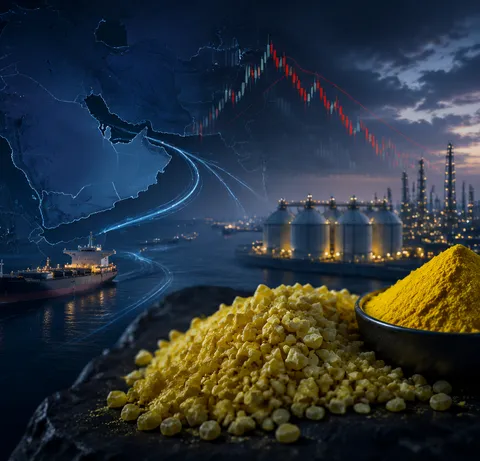
U.S. Department of Agriculture Deputy Secretary Stephen Vaden told Argus in an exclusive interview that relevant U.S. government agencies were studying ways to reduce domestic transportation costs. The objective is to encourage Gulf Coast refineries to export less sulfur and redirect supplies to phosphate fertilizer production.
Sulfur is a by-product of U.S. oil refining. With shipping through the Strait of Hormuz disrupted and other major global sulfur supply channels interrupted, U.S. refiners have become more inclined to increase sulfur exports. This has pushed sulfur prices to record highs and forced phosphate fertilizer producers to reduce output.
U.S. Gulf sulfur spot prices were assessed at USD 1,000-1,050/tonne FOB last week. In the same period of 2025, prices were only USD 280-290/tonne FOB, while quotations in early January 2026 stood at USD 500-510/tonne FOB.
Vaden said the USDA was working closely with the U.S. Department of Transportation. The department has recommended making full use of rail infrastructure to transport sulfur and introducing the necessary incentives to retain domestically produced sulfur in the United States.
"We not only need to retain the sulfur produced in this country, but also optimize rail transportation to ensure that sulfur does not need to be remelted after reaching domestic fertilizer plants," Vaden said.
Sulfur produced by Gulf Coast refineries is generally in molten form. In the domestic market, molten sulfur is transported by rail and truck and, in a small number of cases, by barge. Imported sulfur is generally granular or prilled and must be remelted after arriving at a plant. However, molten sulfur may solidify in transit if temperature controls fail or unloading is delayed.
The U.S. government is currently discussing a proposal with several domestic fertilizer companies to restrict sulfur exports and address persistently high sulfur procurement costs. The discussions are taking place against a backdrop of tight global sulfur supply and continuously rising sulfur prices.
Argus understands that U.S. government officials are currently focused on reducing the cost of transporting sulfur by rail, although other details have yet to be finalized. Sources said several government departments were involved in addressing the domestic sulfur supply issue and that there was strong momentum behind the policy initiative.
Vaden said the proposal could not completely resolve sulfur supply and pricing difficulties in the short term. However, if implemented, it could address various sulfur-related supply chain problems within the next two years.
Market participants have also proposed other alternatives, including establishing a dedicated incentive program to lower sulfur selling prices or introducing a government-funded program modeled on India's approach that would subsidize sulfur procurement costs.
U.S. phosphate fertilizer producers have recently stated repeatedly that rising upstream raw material costs are constraining finished phosphate fertilizer production. Mosaic, a leading U.S. phosphate fertilizer producer, reduced output at its Florida facilities earlier this year and shut down phosphate fertilizer facilities at its Faustina plant in Louisiana.
Higher sulfur costs have also prompted global phosphate fertilizer producers, including Morocco's OCP Group, to reduce their operating rates.
It remains unclear which major industry companies have participated in consultations on the government proposal. Mosaic told Argus that retaining more sulfur for domestic producers would help strengthen the U.S. agricultural supply chain.
Nevertheless, some market participants have offered a different view, arguing that the United States does not face a shortage in total domestic sulfur supply.
"North America produces twice as much sulfur as it consumes," one source said. "The central problem currently facing phosphate fertilizer production is that sulfur prices are too high. Incentives for refineries that lower sulfur selling prices would provide substantive benefits."Other market participants have expressed concern that if sulfur prices become subject to administrative intervention or a subsidy mechanism, other segments of the fertilizer supply chain could subsequently also be brought under government oversight.
Several members of Congress from Florida, where much of Mosaic's production capacity is concentrated, recently sent a letter to U.S. President Donald Trump and Commerce Secretary Howard Lutnick.
The letter said sulfur prices had remained at historically high levels since the outbreak of conflict in the Middle East Gulf, causing U.S. domestic phosphate fertilizer production to decline.
The lawmakers called on the U.S. government to take coordinated action to address sulfur supply disruptions and improve procurement costs. They also warned that U.S. food production could be affected if cost pressure from agricultural inputs continued to intensify for farmers.

July 1, 2026, 10:54 AM

July 20, 2026, 1:48 PM
June 22, 2026, 1:36 PM

July 9, 2026, 3:11 PM
June 25, 2026, 10:42 AM